ProstaFlow Official Website › Ingredients
IngredientsProstaFlow Ingredients: The Seven Actives in Each Capsule
ProstaFlow contains seven actives, each with a printed amount.
L-arginine 200 mg, arginine AKG 200 mg, citrulline HCl and citrulline malate at 100 mg each, beta alanine 40 mg, niacin 7.5 mg NE and calcium 18 mg, for 665.5 mg per daily capsule.
Seven substances, the form each one arrives in, and what its weight buys.
Which families do the ProstaFlow ingredients belong to?
The seven rows grouped by what kind of substance each one is.
| Family | Rows | Weight per capsule | What the family is for |
|---|---|---|---|
| Nitric oxide amino acids | L-arginine base, L-arginine AKG 2:1, L-citrulline HCl, L-citrulline malate | 600 mg | Four approaches to one substrate. Arginine is the molecule the body turns into nitric oxide; citrulline is the route that survives the first pass through the gut wall and the liver better. |
| Buffering amino acid | Beta alanine | 40 mg | A carnosine precursor from the sports shelf. It has no nitric oxide role and it is the only row on the panel that belongs to a different story. |
| Vitamin | Niacin, as niacin equivalents | 7.5 mg NE | A B vitamin the body uses to build NAD, the carrier that moves electrons through energy metabolism. Forty-seven per cent of a Daily Value. |
| Mineral | Calcium, as calcium carbonate | 18 mg | One and a half per cent of a Daily Value. At this weight calcium carbonate is the powder that keeps a fill running evenly rather than a nutrient contribution. |
Four families, 665.5 mg of declared actives, one capsule. Sorted by weight rather than by the order the panel prints them, which is set by regulation and puts the vitamin and the mineral first.
Sorting the rows this way answers the question most people arrive with, which is what kind of product this actually is. Six hundred of the 665.5 milligrams belong to one idea: raise the amount of arginine circulating in the blood, because arginine is the raw material for nitric oxide.
The two panel rows that are not amino acids do jobs of their own. Niacin is a genuine nutrient contribution at a food-level amount. Calcium carbonate at 18 mg is a manufacturing decision, and the label is honest enough to print the 1.5 per cent rather than round it up to something that sounds better.
The how it works page follows the arginine from the mouth to the smooth muscle. This page stays with the chemistry in the capsule.
What are the seven ingredients in ProstaFlow?
Seven substances, seven printed weights, and the chemistry of each one.
Each card gives the substance, the form it arrives in, and the quantity the research behind its name actually ran on. The cards are in the panel's own order.
L-Arginine
free base200 mgA conditionally essential amino acid, which means the body makes its own until illness, injury or age gets in the way. It is the direct substrate for nitric oxide synthase, the enzyme family that produces nitric oxide, and it is also a building block for creatine and for urea. The free base is the plain amino acid with no counter-ion attached, so 200 mg of this row is 200 mg of arginine. The 2019 meta-analysis in 540 men pooled ten randomised trials running between 1,500 and 5,000 mg a day.
L-Arginine AKG 2:1 Extract
arginine bound to alpha-ketoglutarate200 mgTwo parts arginine to one part alpha-ketoglutarate, and the ratio is printed, which is the only reason this row can be audited. Alpha-ketoglutarate is an intermediate in the citric acid cycle, and the pairing was adopted by the sports shelf on the theory that it carries arginine into circulation more efficiently. The pharmacokinetic work on it used four grams three times a day for eight weeks in trained men, so the human record sits sixty times above this row.
L-Citrulline HCl
citrulline as a hydrochloride salt100 mgCitrulline is a non-protein amino acid named after the watermelon it was first isolated from. The kidney converts it back into arginine, which is why it raises plasma arginine more reliably than swallowing arginine does. The hydrochloride is the acid salt: it dissolves readily and it is slightly heavier than the free amino acid, so 100 mg of the salt is a little under 100 mg of citrulline. The 2011 study in 24 men used 1,500 mg a day for a month.
L-Citrulline Malate
citrulline bound to malic acid100 mgThe pre-workout form, and the row where the label stops short. Malic acid is the sharp-tasting acid in green apples and another citric acid cycle intermediate. Citrulline malate is sold as 1:1 and as 2:1, and the two carry very different amounts of citrulline for the same weight. This label prints no ratio for it. The meta-analysis of eight studies pooled single doses of six to eight grams taken before lifting.
Beta Alanine
non-essential amino acid, carnosine precursor40 mgBeta alanine joins with histidine inside muscle to form carnosine, a dipeptide that mops up hydrogen ions during hard efforts. It is the rate-limiting half of that reaction, which is why supplementing it raises muscle carnosine while supplementing histidine does not. The ISSN position stand puts the working range at four to six grams a day for four weeks and names 1.6 grams as the split dose used to keep the tingling down. A head-to-head of two dosing protocols compared splitting that daily amount against taking it in one go and found the carnosine rise depends on the total rather than the schedule.
Niacin
vitamin B3, expressed as niacin equivalents7.5 mg NE (47% DV)Niacin equivalents are a unit rather than a compound: one NE is a milligram of nicotinic acid or nicotinamide, or the amount of tryptophan the body converts into that much. The vitamin becomes NAD and NADP, the two carriers that move electrons through every energy-releasing reaction in the body. The Institute of Medicine chapter sets the adult male requirement at 16 mg NE a day and the ceiling at 35 mg. This row is under half the first figure.
Calcium
as calcium carbonate18 mg (1.5% DV)Calcium carbonate is chalk: the same mineral as limestone, eggshell and the white powder in an antacid tablet. Forty per cent of its weight is elemental calcium, and the 18 mg on this panel is the elemental figure rather than the weight of the carbonate. The Institute of Medicine tables put a man's requirement at 1,000 mg a day to age 70 and 1,200 mg above it, so this row is a rounding error against a day's need and a useful flow agent inside a capsule.
What do the salt names on the ProstaFlow panel mean?
Why the word before the amino acid decides what the weight means.
Four of the seven rows name a salt or a complex rather than a bare substance, and that word before the amino acid changes what the milligrams buy.
A salt is the amino acid plus a passenger
Amino acids are sold bound to something because the bare molecule is often hygroscopic, unstable or unpleasant to work with. The passenger has weight, and the weight printed on a panel is normally the weight of the whole salt. That is not a trick; it is the convention, and it is why two products can print the same number and deliver different amounts.
“2:1” is the label doing the reader a favour
The arginine AKG row prints its ratio, so its arithmetic is open: two parts arginine to one part alpha-ketoglutarate makes roughly 133 mg of arginine inside those 200 mg. Very few panels in this category bother. This one did, and it is the single most useful piece of small print on the bottle.
Hydrochloride, malate and carbonate
Hydrochloride adds a proton and a chloride ion, which is a small weight. Malate adds malic acid, which is not small, and the ratio decides how much. Carbonate is the calcium row, where the 18 mg is already stated as elemental calcium so no further sum is needed.
Where this label leaves a gap
The citrulline malate row carries no ratio, so the citrulline inside its 100 mg cannot be worked out from the packaging. The honest reading is to treat those 100 mg as the weight of the salt and to leave the amino acid content unstated rather than guessing at it. Every other row on the panel can be resolved.
How much amino acid is actually in a ProstaFlow capsule?
What the printed weights come to once the passengers are subtracted.
Taking the four amino acid rows apart gives a smaller set of numbers than the panel does, and those smaller numbers are the ones to compare against a trial.
| Row, as printed | Printed weight | Amino acid inside it | How that is derived |
|---|---|---|---|
| L-Arginine (base) | 200 mg | 200 mg of arginine | A free base carries no counter-ion, so the two figures are the same. |
| L-Arginine AKG 2:1 Extract | 200 mg | About 133 mg of arginine | The ratio is printed on the label. Two parts in three of the extract are the amino acid. |
| L-Citrulline HCl | 100 mg | Somewhat under 100 mg of citrulline | A hydrochloride adds a light counter-ion, so the loss is modest rather than negligible. |
| L-Citrulline Malate | 100 mg | Left open by the label | No ratio is given, and a 1:1 salt and a 2:1 salt carry very different amounts of citrulline for the same weight. |
| Arginine, combined | 400 mg of rows | About 333 mg of arginine | The base row plus the calculable part of the AKG row. |
| Citrulline, combined | 200 mg of rows | Under 200 mg, exact figure open | One salt resolves approximately and the other does not resolve at all. |
The right-hand column is arithmetic on the printed label, not an assay. A certificate of analysis is the document that would settle any of it, and reference PRO-1730-26-PR is a filing reference rather than that document.
Two conclusions come out of the table and they pull in opposite directions. The first is that this panel is unusually resolvable: six of its seven rows can be turned into a real quantity by anyone with a calculator, which is more than most bottles on this shelf allow.
The second is the quantity itself. Roughly 333 mg of arginine sits against a pooled trial range that starts at 1,500 mg a day and runs to five grams. Under 200 mg of citrulline salts sits against the 1,500 mg used in the study that reported something. Forty milligrams of beta alanine sits against four to six grams. The distance is between five-fold and a hundred-fold depending on the row, and the dosage comparison on the home page prints it as a single table.
If you are weighing this bottle against another, 333 mg of arginine and 200 mg of citrulline salts are the numbers to carry, not 665.5 mg. The total includes a vitamin, a mineral and a counter-ion or two, and a rival panel quoting grams of a single amino acid is not quoting the same kind of figure.
Why does the ProstaFlow ingredient graphic list six?
The artwork and the panel give different totals, and only one of them is regulated.
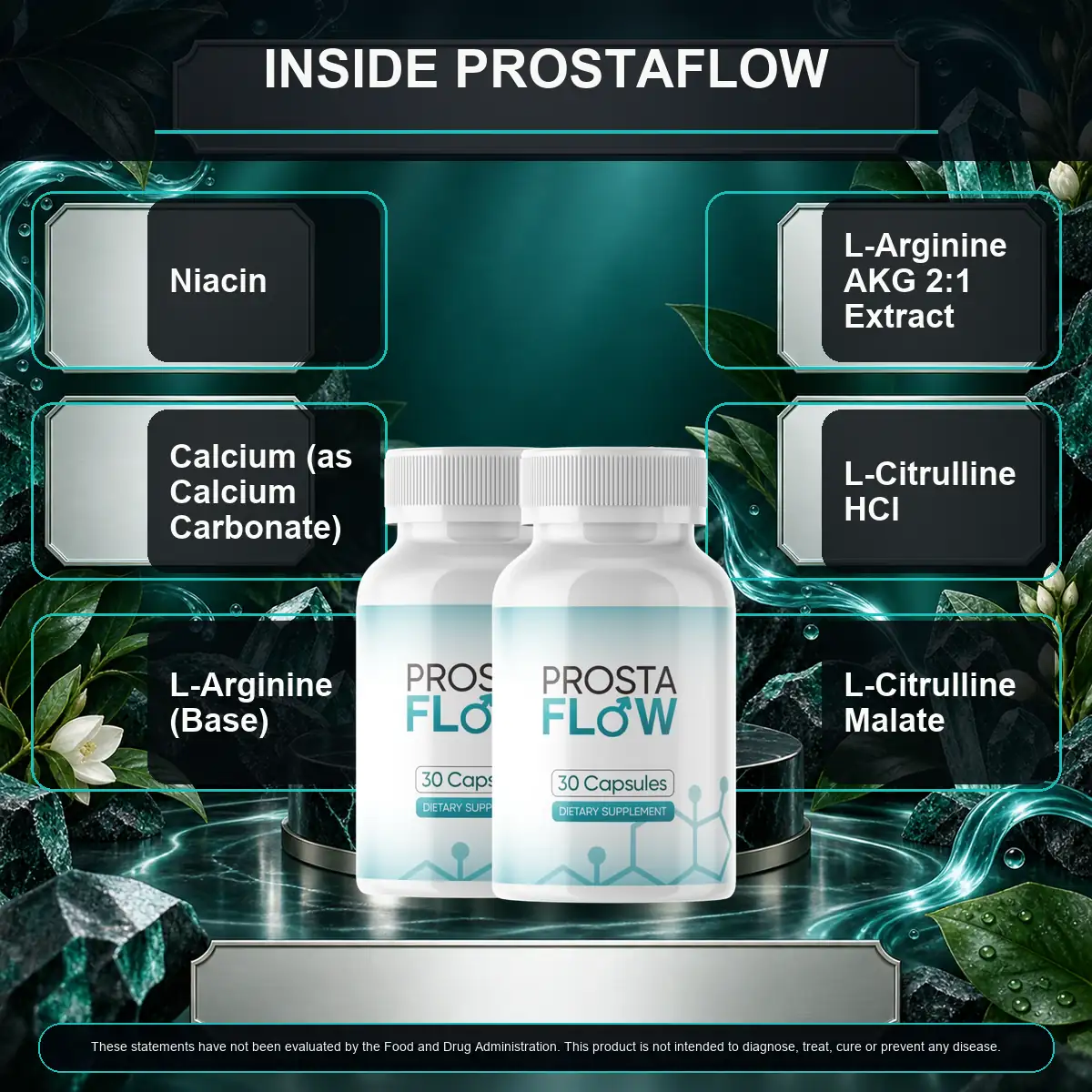
Two counts circulate for this formula. The supplier's own ingredient artwork names Niacin, Calcium (as Calcium Carbonate), L-Arginine (Base), L-Arginine AKG 2:1 Extract, L-Citrulline HCl and L-Citrulline Malate, which is six. The printed Supplement Facts panel adds Beta Alanine 40 mg, which makes seven.
A panel is a regulated declaration with a defined format and a legal meaning. A listing graphic is artwork made for a shopping page. Where the two differ, the seven-row panel is the document this website works from, and the artwork is reproduced beside this paragraph exactly as the supplier drew it rather than redrawn to agree.
Compare the bottle you receive against the transcription rather than against any picture. The batch page sets out what to do if the two disagree.
What else is inside a ProstaFlow capsule?
Three entries under the panel, and what each of them is doing there.
Three lines account for everything that is not an active: hypromellose (vegetable capsule), vegetable stearate, silicon dioxide.
Hypromellose, the shell
Hydroxypropyl methylcellulose, made from plant cellulose. It is the vegetable alternative to a gelatin capsule, it dissolves in water at body temperature, and it keeps a hygroscopic amino acid powder away from the air. For a reader avoiding animal-derived ingredients this single word settles the product, and it settles it the helpful way.
Vegetable stearate, the lubricant
A salt of stearic acid from a plant source. Powder moving through a capsule machine sticks to the tooling without one, which shows up as uneven fill weights rather than as anything a buyer would notice. Half a per cent of the mix is a typical inclusion.
Silicon dioxide, the flow agent
Purified silica, added in tiny quantities to stop fine powders clumping in humid air. It is inert, it passes through, and it is on the other-ingredients line of a very large fraction of the capsules on any shelf.
No sugar, no sweetener, no flavouring, no colour and no preservative appears anywhere on this label. None of the three inactive entries is a gluten, dairy, soy or nut source. The shell is the one that decides the product for a vegetarian buyer, and who it is for takes that further.
Which prostate ingredients are absent from ProstaFlow?
The five ingredients a buyer expects here, and where this formula went instead.
Anyone comparing this label against a shelf will notice the same thing, and it is better answered in one place than left to be discovered. The ingredients this category was built on are saw palmetto, beta-sitosterol, pygeum africanum, zinc and lycopene. None of the seven rows on this panel is one of them.
That is a statement about what kind of formula this is rather than a verdict on it. The 2023 Cochrane review of saw palmetto gathered 27 studies in 4,656 men and reported, at high certainty, little to no benefit for urinary symptoms, so the classic ingredient with the largest trial base is not the sure thing a shelf implies either.
What this panel offers instead is an amino acid approach to nitric oxide signalling, a pathway that genuinely exists in the lower urinary tract and that prescription medicines in this indication reach by a different route. Whether that trade appeals is a reader's decision, and it is a decision only available to somebody who has been told plainly what is on the bottle.
ProstaFlow ingredient questions
How many ingredients does ProstaFlow have?
Seven actives, each with its own printed milligram figure, plus three inactive entries: hypromellose (vegetable capsule), vegetable stearate, silicon dioxide. The supplier's ingredient artwork names six of the seven; the Supplement Facts panel is the count that governs.
Is there a proprietary blend?
There is no blend anywhere on this label. Every active carries its own row and its own amount, which is what makes each one checkable against a published trial.
Which ingredient is present in the largest amount?
Two rows tie at 200 mg: L-arginine as the free base, and the arginine AKG 2:1 extract. Between them they carry roughly 333 mg of arginine, which is a little over half the declared active weight in the capsule.
What is arginine AKG, in plain terms?
Arginine bound to alpha-ketoglutarate in a two-to-one ratio. Alpha-ketoglutarate is a molecule from the citric acid cycle, and the pairing came from sports nutrition. The printed ratio is what lets the arginine content be calculated.
Why are there two citrulline rows instead of one?
The panel splits 200 mg of citrulline across a hydrochloride and a malate. A 2025 head-to-head comparison of plain citrulline against citrulline malate is the reason this desk treats the split as a formulation choice rather than an advantage.
Is ProstaFlow vegetarian?
The shell is hypromellose, a plant cellulose capsule rather than gelatin, and neither of the other two inactive entries is animal-derived. In a category where gelatin is the default, that is worth knowing before you compare packs.
Does the capsule contain any stimulant?
No row on this panel is a stimulant. There is no caffeine, no yohimbine and no botanical extract of any kind. The strongest thing in the capsule is 7.5 mg NE of a B vitamin.
How do I check the ingredients on the bottle that arrives?
Read the panel on the back against the table on the supplement facts page, which reproduces all seven rows in the label's own order. If a row differs, the batch page says what to do next.
Sources behind the ProstaFlow ingredient list
Each study named above, in the order the panel prints the row it belongs to.
- Rhim HC, Kim MS, Park YJ, et al. The Potential Role of Arginine Supplements on Erectile Dysfunction: A Systemic Review and Meta-Analysis. J Sex Med. 2019;16(2):223-234. PMID 30770070. https://pubmed.ncbi.nlm.nih.gov/30770070/
- Campbell B, Roberts M, Kerksick C, et al. Pharmacokinetics, safety, and effects on exercise performance of L-arginine alpha-ketoglutarate in trained adult men. Nutrition. 2006;22(9):872-81. PMID 16928472. https://pubmed.ncbi.nlm.nih.gov/16928472/
- Cormio L, De Siati M, Lorusso F, et al. Oral L-citrulline supplementation improves erection hardness in men with mild erectile dysfunction. Urology. 2011;77(1):119-22. PMID 21195829. https://pubmed.ncbi.nlm.nih.gov/21195829/
- Varvik FT, Bjornsen T, Gonzalez AM. Acute Effect of Citrulline Malate on Repetition Performance During Strength Training: A Systematic Review and Meta-Analysis. Int J Sport Nutr Exerc Metab. 2021;31(4):350-358. PMID 34010809. https://pubmed.ncbi.nlm.nih.gov/34010809/
- Martin-Olmedo JJ, Miras-Moreno S, Cuadra-Montes K, et al. Malate or Not? Acute Effects of L-Citrulline Versus Citrulline Malate on Neuromuscular Performance in Young, Trained Adults: A Randomized, Double-Blind Study. Int J Sport Nutr Exerc Metab. 2025;35(2):89-98. PMID 39662304. https://pubmed.ncbi.nlm.nih.gov/39662304/
- Trexler ET, Smith-Ryan AE, Stout JR, et al. International society of sports nutrition position stand: Beta-Alanine. J Int Soc Sports Nutr. 2015;12:30. PMID 26175657. https://pubmed.ncbi.nlm.nih.gov/26175657/
- Church DD, Hoffman JR, Varanoske AN, et al. Comparison of Two beta-Alanine Dosing Protocols on Muscle Carnosine Elevations. J Am Coll Nutr. 2017;36(8):608-616. PMID 28910200. https://pubmed.ncbi.nlm.nih.gov/28910200/
- Institute of Medicine (US) Standing Committee on the Scientific Evaluation of Dietary Reference Intakes. Niacin. In: Dietary Reference Intakes for Thiamin, Riboflavin, Niacin, Vitamin B6, Folate, Vitamin B12, Pantothenic Acid, Biotin, and Choline. Washington (DC): National Academies Press; 1998. NCBI Bookshelf NBK114304. https://www.ncbi.nlm.nih.gov/books/NBK114304/
- Institute of Medicine (US) Committee to Review Dietary Reference Intakes for Vitamin D and Calcium; Ross AC, Taylor CL, Yaktine AL, Del Valle HB, editors. Summary Tables. In: Dietary Reference Intakes for Calcium and Vitamin D. Washington (DC): National Academies Press; 2011. NCBI Bookshelf NBK56068. https://www.ncbi.nlm.nih.gov/books/NBK56068/
- Franco JV, Trivisonno L, Sgarbossa NJ, et al. Serenoa repens for the treatment of lower urinary tract symptoms due to benign prostatic enlargement. Cochrane Database Syst Rev. 2023;6(6):CD001423. PMID 37345871. https://pubmed.ncbi.nlm.nih.gov/37345871/
Order ProstaFlow with all seven amounts in front of you
Seven rows, seven printed figures, 30 capsules in a bottle and 60 days from despatch in which to decide.
Two bottles $158 · six bottles $294 · 60-day money-back guarantee
Order ProstaFlow On The Official WebsiteOne capsule a day · 30 per bottle · lot PRO-26/PR-1730