ProstaFlow Official Website › How it works
How it worksHow Does ProstaFlow Work? One Chain, Step by Step
ProstaFlow works mainly through one chain: arginine to nitric oxide.
Cells turn arginine into nitric oxide, which helps relax smooth muscle, including in the bladder neck and prostate. Citrulline is an indirect route to the same arginine.
One pathway, six steps, and an honest account of where it thins out.
What chain of events does ProstaFlow set off?
Six steps between swallowing the capsule and a smooth muscle cell relaxing.
Nitric oxide is not swallowed. It is made, on demand, inside the cells that line every blood vessel in the body, and the raw material is arginine. Follow one capsule's worth of arginine through in order and the proposition becomes concrete.
The capsule opens in the stomach
Hypromellose softens in water at body temperature and releases 665.5 mg of powder within minutes. The label asks for a full 8 oz glass and a 20 to 30 minute gap before eating, which is the shell's best chance of emptying into an uncrowded small intestine.
The small intestine absorbs the amino acids
Arginine crosses the gut wall on a transporter it shares with lysine and ornithine, which is why a large protein meal slows it down. Citrulline uses a different transporter and is not competing with the same traffic. That is the first place the two molecules behave differently.
The liver takes its share of the arginine
Hepatic arginase converts a substantial part of any swallowed arginine into ornithine and urea before it reaches the general circulation. Citrulline skips that toll entirely: the kidney converts it into arginine after the liver, which is why a six-arm crossover study in 20 volunteers found citrulline raised plasma arginine more efficiently than arginine itself did.
Nitric oxide synthase does the work
In the endothelium, the single-cell lining of a blood vessel, an enzyme takes arginine and oxygen and produces nitric oxide and citrulline. The citrulline is recycled back to arginine on the spot, a loop that keeps the enzyme supplied without waiting for the next meal.
The signal reaches smooth muscle
Nitric oxide diffuses into the muscle layer and activates soluble guanylate cyclase, which makes cyclic GMP. Cyclic GMP relaxes smooth muscle. That is the whole signal, and it is the same signal in a coronary artery, in a bladder neck and in the stroma of a prostate.
An enzyme switches the signal off
Phosphodiesterase type 5 breaks cyclic GMP down again, which is how the relaxation ends. Blocking that enzyme is what a prescription PDE5 inhibitor does, and the review of how those drugs act in the lower urinary tract sets out why the class was brought into this indication at all.
Why is a nitric oxide pathway on a ProstaFlow prostate label?
The tissue this signal reaches, and why prescription medicine got there first.
The connection is real and it is older than this product. A review of the arginine, nitric oxide and guanylate cyclase pathway described it as a mediator of lower urinary tract physiology in 2003. Nitric oxide synthase is found in the bladder neck, in the urethra and in prostatic stroma, and the tone of that muscle is part of what decides how comfortable the whole arrangement feels.
That is the reason the pharmaceutical industry pointed a PDE5 inhibitor at this indication in the first place. The drug does not shrink anything. It leaves cyclic GMP in place for longer, and the muscle stays relaxed.
So the pathway is a genuine target rather than a marketing story. The open question on this bottle is whether feeding the substrate end of that pathway with a few hundred milligrams a day does anything at the other end of it, and that question is taken up two sections below.
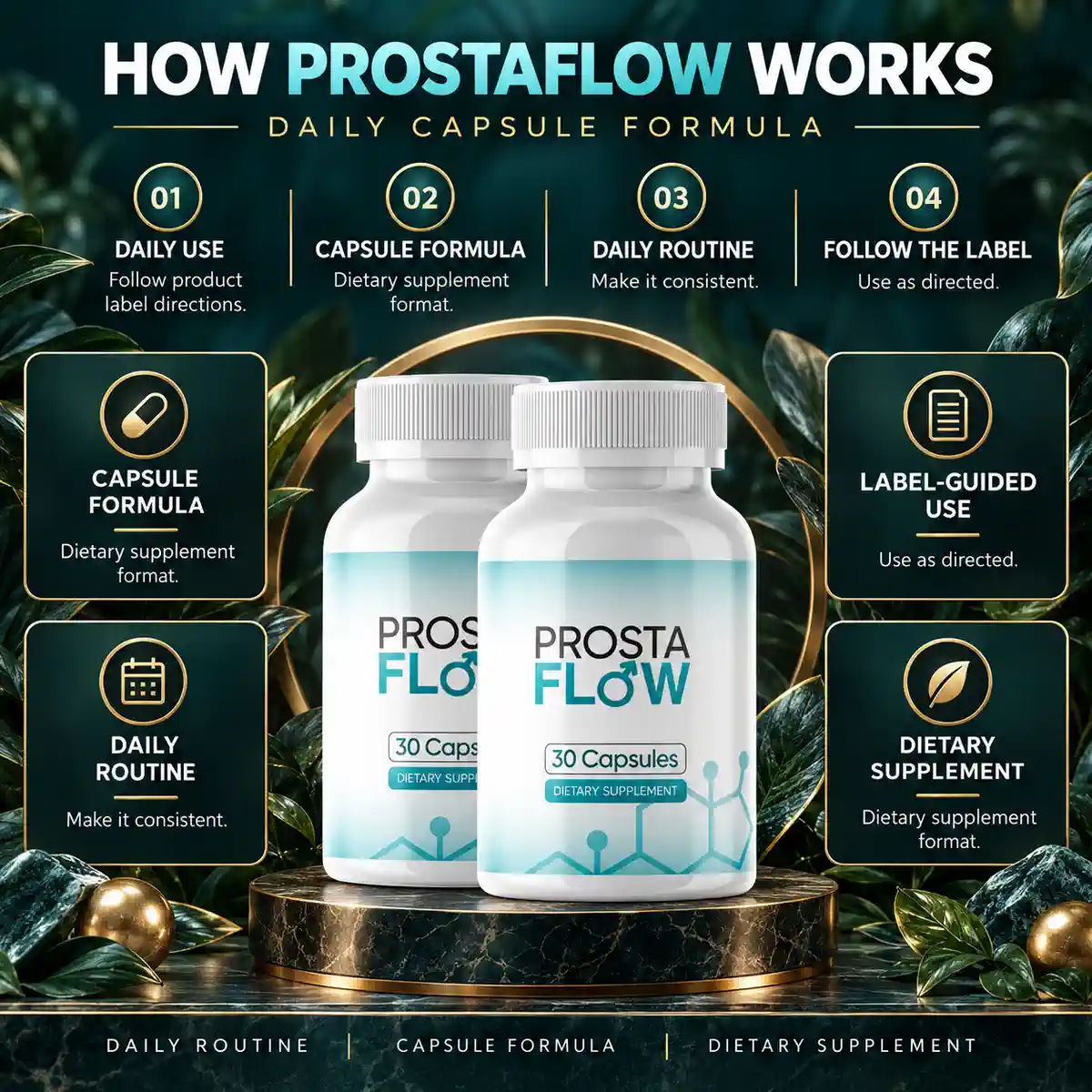
The supplier's own graphic beside this text describes a routine rather than a mechanism: daily use, the capsule, the habit, follow the label. The six steps above are this desk's account, taken from the published work.
What are the two nutrient rows doing in ProstaFlow?
Four short answers about the three rows that are not part of the arginine story.
Niacin becomes NAD
The vitamin is converted into nicotinamide adenine dinucleotide, the carrier that shuttles electrons through the reactions releasing energy from food. That is a genuine and well-understood job, and 7.5 mg NE makes a real contribution to a day's requirement of 16 mg NE without approaching the 35 mg ceiling the Institute of Medicine set.
Niacin also relaxes vessels, but not at this amount
The flush people associate with niacin is itself a vasodilation: nicotinic acid triggers prostaglandin release in the skin. The mechanism review describes it as a gram-scale phenomenon, and the outcome trials that made niacin famous used one and a half to two grams a day. At 7.5 mg NE the vitamin is here as a vitamin.
Calcium carbonate is doing a job in the machine
Eighteen milligrams is 1.5 per cent of a Daily Value. Calcium carbonate at that level is a diluent and a flow aid, and the label prints the percentage rather than hiding it. Reading this row as a nutrient contribution would overstate it by a factor of fifty.
Beta alanine belongs to a different shelf
Carnosine buffering is a sports proposition, tested on efforts lasting over a minute. The performance meta-analysis pooled 15 studies at a median total intake of 179 grams. There is no nitric oxide story here and no urinary one, so this row is described rather than explained away.
Does age change how the ProstaFlow pathway behaves?
Two trials in exactly this age group, and the two caveats that go with them.
Most buyers in this category are past fifty, and the honest answer is that the pathway is one of the few things about this product where that works in a buyer's favour rather than against it.
Endothelial nitric oxide production falls with age, and the two studies that examined citrulline in exactly this group found something rather than nothing. A 2022 trial in older adults reported an effect on aortic pulse pressure and wave reflection under cold stress, and a 2025 trial in middle-aged and older adults with type 2 diabetes reported improvements in microvascular function and muscle strength.
Both used grams a day rather than milligrams, which is the same caveat that attaches to every study on this page and is set out in the section below. What they do establish is that the substrate end of this chain is not inert in an older population, which is a more interesting starting point than the alternative.
They also say nothing about urinary symptoms, because neither measured them. A result in one tissue is not a result in another, and the one study that did measure urinary symptoms is a different design entirely.
Where does the ProstaFlow mechanism stop being an argument?
The three studies that decide how far a mechanism carries at these quantities.
A pathway that exists and a capsule that reaches it are two different claims, and the honest place to separate them is here.
The pharmacokinetic work is the clearest guide. The six-arm crossover tested citrulline and arginine at several amounts for a week each. Only the largest arm, three grams of citrulline twice a day, moved the arginine to ADMA ratio and the urinary markers of nitric oxide production. No arm improved flow-mediated dilation, which is the standard physiological readout. This capsule carries under 200 mg of citrulline salts.
The arginine AKG story runs the same way. A seven-day study in 24 active men gave 12 grams a day and measured brachial artery blood flow. Flow rose, and it rose in the placebo arm too, so the authors credited the resistance exercise rather than the powder. An acute trial found no performance effect at all.
And the closest thing to direct evidence is a single 16-week open-label study in which 20 men took 460 mg a day of L-arginine bundled with 40 mg of Pycnogenol. The pine bark extract was the nitric oxide donor in that product, and this formula carries none. The home page sets that trial out in full.
Understanding the chain is worth something even when the amounts are small: it tells you what this product is trying to do, which rival products are doing the same thing, and which questions to ask of any panel that claims a flow benefit. It does not tell you that one capsule a day reaches the end of the chain, and nothing on this website says it does.
What ProstaFlow does not do
Five things the chain above cannot be stretched to cover.
- It does not reduce the size of a prostate. Nothing in the nitric oxide chain acts on tissue volume, and no dietary supplement may claim that it does.
- It does not replace a prescription. A PDE5 inhibitor works by blocking an enzyme at a prescribed dose, which is a different intervention at a different scale.
- It does not act on hormones. There is no 5-alpha reductase story here, no testosterone story and no oestrogen story. Those belong to other ingredients.
- It does not work quickly. Nothing on the panel is a stimulant, and the chain above describes a signalling system rather than a sensation.
- It does not move cancer risk in either direction. No row on this panel has been shown to, and this desk makes no suggestion of it.
Questions about how ProstaFlow works
How is ProstaFlow supposed to work, in one sentence?
Four amino acid rows feed the arginine that endothelial cells convert into nitric oxide, a signal that relaxes smooth muscle through cyclic GMP, and that signalling system is present in the lower urinary tract.
Why does the panel carry citrulline as well as arginine?
Because citrulline avoids the liver enzyme that breaks arginine down on the way in. The kidney converts it into arginine afterwards, so it raises plasma arginine more efficiently than arginine does.
Is nitric oxide the same thing as nitrous oxide?
No. Nitrous oxide is the anaesthetic gas. Nitric oxide is a signalling molecule made inside the body from arginine and oxygen, with a half-life measured in seconds.
Does the pathway have anything to do with the prostate specifically?
Nitric oxide synthase is present in the bladder neck, the urethra and prostatic stroma, and the tone of that smooth muscle is part of the picture. That is why the PDE5 inhibitor class was brought into this indication.
Would a bigger capsule work better?
The trials that moved a marker used grams rather than milligrams, so the question is fair. What this desk can say is that the amounts on this label sit well below them, which is set out on the ingredients page.
Why is beta alanine here if it has no role in the chain?
It raises muscle carnosine, which buffers acidity during hard efforts. It is a sports ingredient, it is printed at 40 mg, and this website describes it as what it is rather than folding it into the nitric oxide story.
Sources for the ProstaFlow mechanism
Every paper named above, grouped the way the chain runs.
- Schwedhelm E, Maas R, Freese R, et al. Pharmacokinetic and pharmacodynamic properties of oral L-citrulline and L-arginine: impact on nitric oxide metabolism. Br J Clin Pharmacol. 2008;65(1):51-9. PMID 17662090. https://pubmed.ncbi.nlm.nih.gov/17662090/
- Willoughby DS, Boucher T, Reid J, et al. Effects of 7 days of arginine-alpha-ketoglutarate supplementation on blood flow, plasma L-arginine, nitric oxide metabolites, and asymmetric dimethyl arginine after resistance exercise. Int J Sport Nutr Exerc Metab. 2011;21(4):291-9. PMID 21813912. https://pubmed.ncbi.nlm.nih.gov/21813912/
- Wax B, Kavazis AN, Webb HE, et al. Acute L-arginine alpha ketoglutarate supplementation fails to improve muscular performance in resistance trained and untrained men. J Int Soc Sports Nutr. 2012;9(1):17. PMID 22510253. https://pubmed.ncbi.nlm.nih.gov/22510253/
- Stothers L, Laher I, Christ GT. A review of the L-arginine - nitric oxide - guanylate cyclase pathway as a mediator of lower urinary tract physiology and symptoms. Can J Urol. 2003;10(5):1971-80. PMID 14633324. https://pubmed.ncbi.nlm.nih.gov/14633324/
- Giuliano F, Uckert S, Maggi M, et al. The mechanism of action of phosphodiesterase type 5 inhibitors in the treatment of lower urinary tract symptoms related to benign prostatic hyperplasia. Eur Urol. 2013;63(3):506-16. PMID 23018163. https://pubmed.ncbi.nlm.nih.gov/23018163/
- Jaime SJ, Nagel J, Maharaj A, et al. L-Citrulline supplementation attenuates aortic pulse pressure and wave reflection responses to cold stress in older adults. Exp Gerontol. 2022;159:111685. PMID 34990772. https://pubmed.ncbi.nlm.nih.gov/34990772/
- Figueroa A, Dillon KN, Levitt DE, et al. Citrulline Supplementation Improves Microvascular Function and Muscle Strength in Middle-Aged and Older Adults with Type 2 Diabetes. Nutrients. 2025;17(17):2790. PMID 40944179. https://pubmed.ncbi.nlm.nih.gov/40944179/
- Institute of Medicine (US) Standing Committee on the Scientific Evaluation of Dietary Reference Intakes. Niacin. In: Dietary Reference Intakes for Thiamin, Riboflavin, Niacin, Vitamin B6, Folate, Vitamin B12, Pantothenic Acid, Biotin, and Choline. Washington (DC): National Academies Press; 1998. NCBI Bookshelf NBK114304. https://www.ncbi.nlm.nih.gov/books/NBK114304/
- Kamanna VS, Ganji SH, Kashyap ML. The mechanism and mitigation of niacin-induced flushing. Int J Clin Pract. 2009;63(9):1369-77. PMID 19691622. https://pubmed.ncbi.nlm.nih.gov/19691622/
- Hobson RM, Saunders B, Ball G, et al. Effects of beta-alanine supplementation on exercise performance: a meta-analysis. Amino Acids. 2012;43(1):25-37. PMID 22270875. https://pubmed.ncbi.nlm.nih.gov/22270875/
Order ProstaFlow knowing which pathway it aims at
One capsule a day out of a 30-count bottle, four amino acid rows on a single pathway, and 60 days from despatch to reach a verdict.
Two bottles $158 · six bottles $294 · 60-day money-back guarantee
Order ProstaFlow On The Official WebsiteOne capsule a day · 30 per bottle · lot PRO-26/PR-1730