ProstaFlow Official Website › Blog › What Is Actually In ProstaFlow
What Is Actually In ProstaFlow? The Panel, Read Aloud
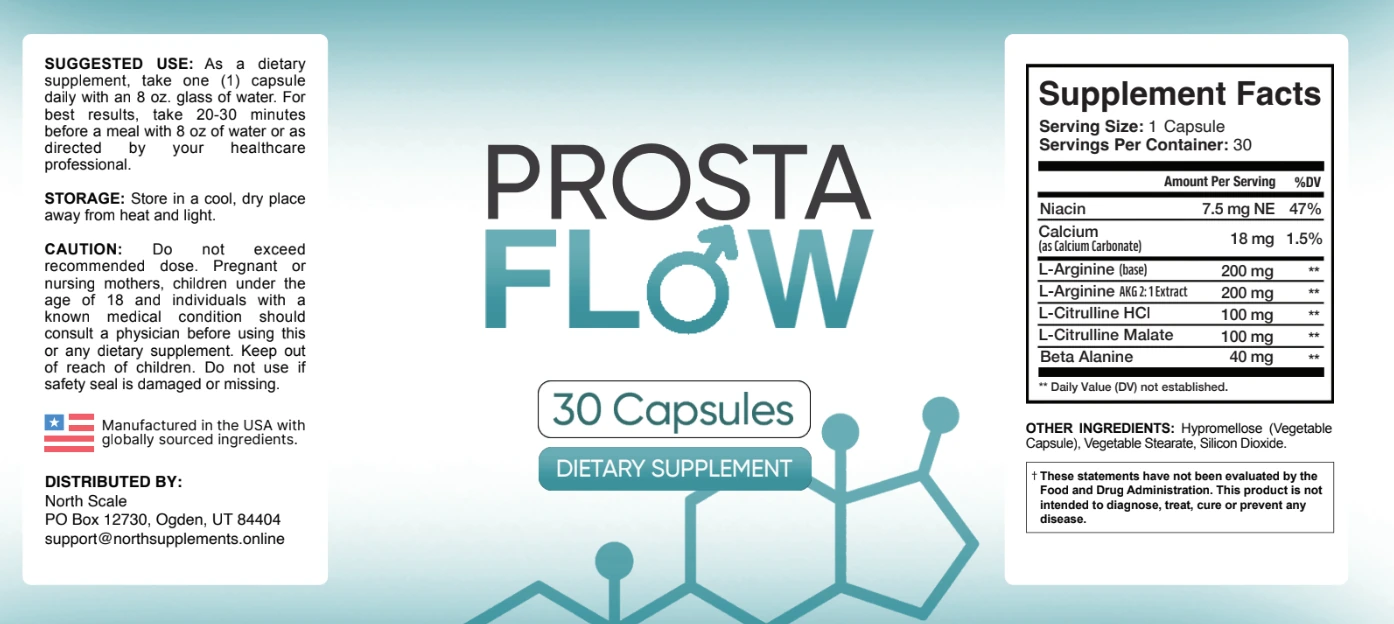
The seller's own sales page names no ingredients at all. The bottle carries a complete seven-row Supplement Facts panel with an amount against every line. This is that panel, transcribed and explained, for anybody who wants to know what is in the capsule before it arrives.
- Seven actives, each with a printed milligram figure. No proprietary blend anywhere on the label.
- 665.5 mg of declared actives in one capsule, ninety per cent of it four amino acid rows aimed at nitric oxide.
- Two nutrient rows: niacin at 7.5 mg NE and calcium at 18 mg, both honestly small and both with correct percentages.
- The supplier's own ingredient graphic names six of the seven. The printed panel is the document that governs.
- Not one of the seven is a classic prostate ingredient, which is the most important sentence on this page.
What the bottle itself says
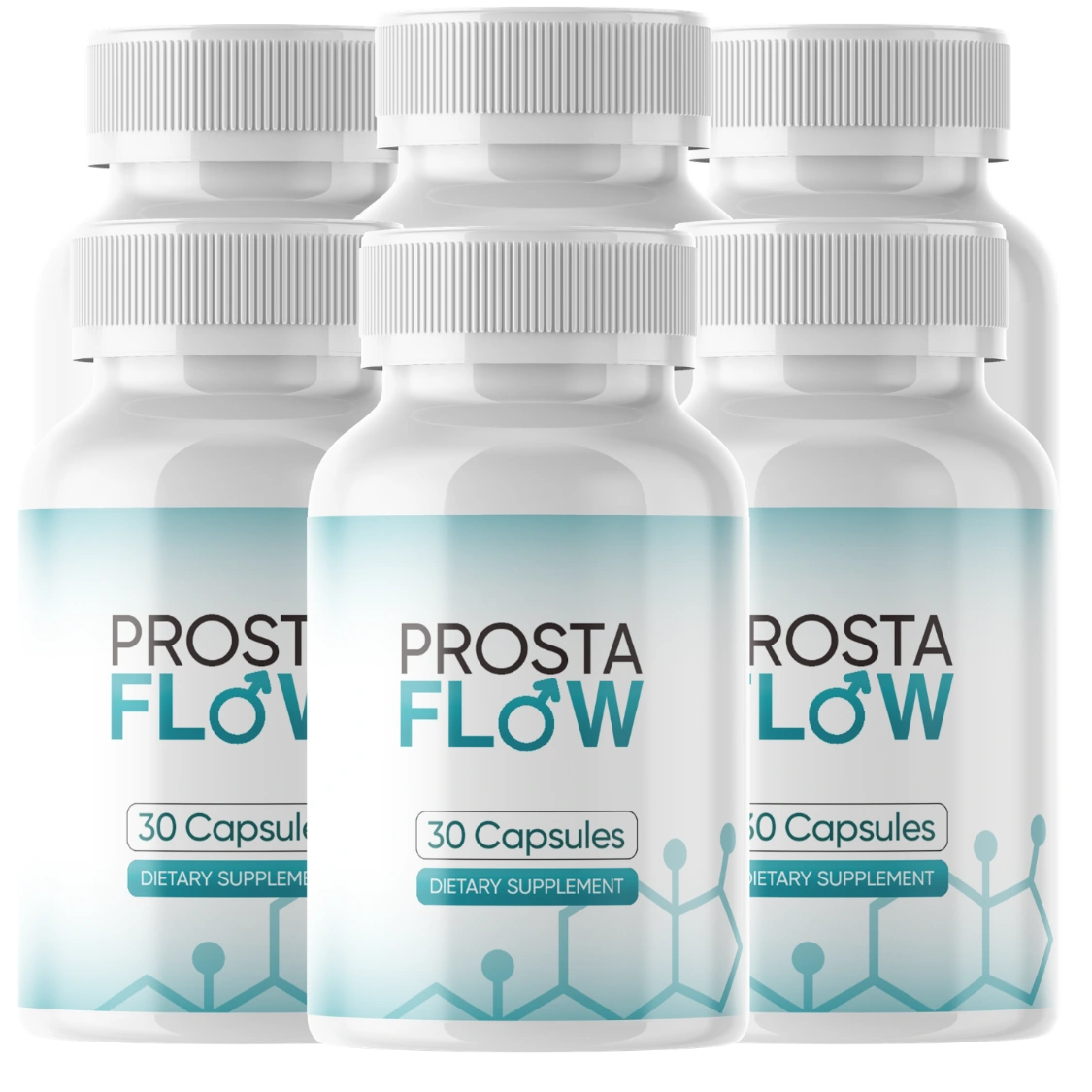
The front of the bottle is almost empty. It carries the brand set as two words, with the astronomical symbol for Mars standing in for the letter O of the second, the count, the words dietary supplement, and a molecular graphic along the base. There is no benefit line on it at all, and the word prostate appears only inside the brand name.
That is unusual on this shelf, where a front label is normally the busiest surface on the pack. It means a buyer holding the bottle has nothing to go on until they turn it over, and it means this website has nothing to argue with when it describes the product.
The back is where everything checkable lives: the panel, the other-ingredients line, the suggested use with its timing, the storage line, the caution, the origin line, the distributor block and the disclaimer. The base carries the lot and the best-before date.
The seven rows, one at a time
Here is the panel, transcribed in the order the label sets it, with a plain description of each substance in the last column.
| Row, as the bottle prints it | Per capsule | % Daily Value | What it is |
|---|---|---|---|
| Niacin | 7.5 mg NE | 47% | Vitamin B3, expressed in niacin equivalents |
| Calcium (as Calcium Carbonate) | 18 mg | 1.5% | Elemental calcium from chalk |
| L-Arginine (base) | 200 mg | None set | The plain amino acid, with no counter-ion attached |
| L-Arginine AKG 2:1 Extract | 200 mg | None set | Arginine bound to alpha-ketoglutarate, two parts to one |
| L-Citrulline HCl | 100 mg | None set | Citrulline as a hydrochloride salt |
| L-Citrulline Malate | 100 mg | None set | Citrulline bound to malic acid |
| Beta Alanine | 40 mg | None set | A carnosine precursor from the sports shelf |
Serving size one capsule, thirty servings a container. The bottle marks the five rows with no established Daily Value using a double asterisk and a footnote.
Two things about that table are worth pausing on before anything else. The first is that every row has a number. A great deal of this category prints a blend total for a list of names, and nothing can be checked against a blend. The second is that the percentages on the two nutrient rows are arithmetically correct: 7.5 divided by 16 is 46.9, which rounds to the printed 47.
The five rows with no percentage are not being evasive. No Daily Value has ever been set for arginine, citrulline or beta alanine, because there is no established daily requirement for any of the three. The footnote is the correct mark for that and it is what the label uses.
Four families, one idea
Grouping the rows by what kind of substance each one is answers the question most people arrive with, which is what sort of product this actually is.
| Family | Rows | Weight | Share of the declared actives |
|---|---|---|---|
| Nitric oxide amino acids | Four | 600 mg | About 90 per cent |
| Buffering amino acid | One | 40 mg | About 6 per cent |
| Vitamin | One | 7.5 mg NE | Just over 1 per cent |
| Mineral | One | 18 mg | Under 3 per cent |
Sorted by weight rather than by the order the panel prints them, which regulation fixes and which puts the vitamin and the mineral first.
Six hundred of the 665.5 milligrams belong to a single idea: raise the amount of arginine circulating in the blood, because arginine is the raw material the body turns into nitric oxide. Four rows approach that from three directions.
Why four rows for one substrate
L-arginine as the free base is the direct route. The arginine AKG extract is the same amino acid bound to alpha-ketoglutarate, a form the sports shelf adopted on the theory that it delivers better. The two citrulline salts are the indirect route: the kidney converts citrulline back into arginine after the liver has taken its share, which is the one genuinely clever thing about the design of this panel.
The three rows outside that idea
Beta alanine has no nitric oxide story at all. It raises muscle carnosine, which buffers acidity during hard efforts, and the ISSN position stand puts its working range at four to six grams a day. Niacin becomes NAD, the carrier that moves electrons through energy metabolism. Calcium carbonate at 18 mg is doing the job of a flow agent inside the capsule rather than making a nutritional contribution.
Why the ingredient graphic shows six
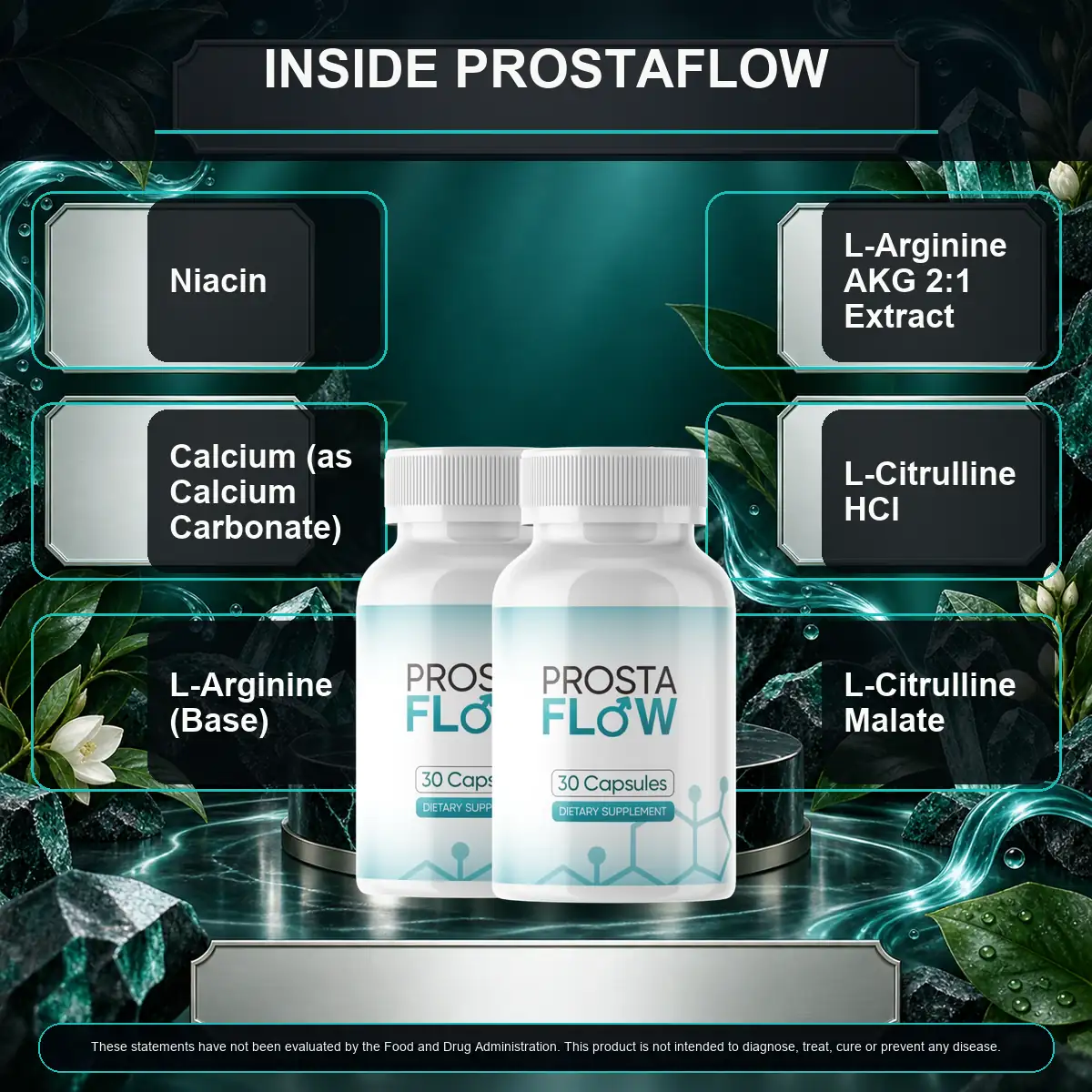
Two counts circulate for this formula and only one comes off the bottle. The graphic above names Niacin, Calcium (as Calcium Carbonate), L-Arginine (Base), L-Arginine AKG 2:1 Extract, L-Citrulline HCl and L-Citrulline Malate. The panel adds Beta Alanine 40 mg.
One of those two documents is drawn for a shopping page and the other is a declaration with a fixed format and rules behind it. When they disagree the drawing loses, so seven is the figure this post works from, and the artwork above is reproduced as the supplier made it rather than quietly redrawn to agree.
The practical instruction is to count the rows on the bottle that arrives rather than to trust any picture, including this one. It takes five seconds and it is the single fastest check anybody can run. The panel page is what to count against.
Beta alanine is a sports ingredient rather than a prostate one, and it is the row the artwork leaves out. A graphic that happens to omit the least category-typical ingredient is worth noticing, whatever the reason for it.
What the other-ingredients line settles
Beneath the panel the label prints three entries and they account for everything in the capsule that is not an active.
- Hypromellose (vegetable capsule). The shell, made from plant cellulose rather than from gelatin. In a category where gelatin is the default, this single word settles the product for a vegetarian buyer.
- Vegetable stearate. A plant-sourced lubricant. Powder sticks to capsule tooling without one, which shows up as uneven fill weights rather than as anything a buyer would see.
- Silicon dioxide. Purified silica in very small quantity, added to stop a fine powder clumping in humid air.
What the line also rules out is worth reading. There is no sugar, no sweetener, no flavouring, no colour and no preservative on this label. None of the three entries is a gluten, dairy, soy or nut source. A capsule avoids a whole set of questions that a gummy cannot.
Read the whole ProstaFlow panel before deciding
Seven rows, seven printed amounts, one capsule a day out of a 30-count bottle, and 60 days from despatch in which to change your mind.
Two bottles $158 · six bottles $294 · 60-day money-back guarantee
Order ProstaFlow On The Official WebsiteOne capsule a day · 30 per bottle · lot PRO-26/PR-1730
The five ingredients that are not here
Put this bottle beside four others in the same category and one thing separates it immediately. Saw palmetto, beta-sitosterol, pygeum africanum, zinc and lycopene are the names the shelf is built from, and this panel carries no trace of any of them.
Whether that counts against the bottle depends on what those five names are worth. Cochrane looked at the most-used of them in 2023, pooling 27 studies in 4,656 men, and concluded at high certainty that saw palmetto alone offers little to no benefit for urinary symptoms. A shelf full of a thing is not the same as a shelf full of evidence.
So the trade on offer here is a pathway in place of a trial record, and it is a trade rather than a swindle. A reader who has been handed both halves of it can weigh them; a reader who has not cannot. The category guide works through all five of the missing names in turn.
Knowing what is in a capsule is useful after somebody has looked at the symptoms and not before. ProstaFlow is a dietary supplement rather than a treatment for an enlarged prostate, and reading a panel is not a substitute for an appointment that would take twenty minutes.
What 665.5 mg actually buys
A total is easy to quote and easy to misread, so it is worth taking apart once.
Of the 665.5 milligrams, 400 are the two arginine rows and 200 are the two citrulline salts. Take the counter-ions out and the capsule carries roughly 333 mg of arginine, because the AKG row prints its 2:1 ratio and two parts in three of it are the amino acid. The citrulline figure cannot be resolved the same way, because the malate row prints no ratio.
Those are the numbers to carry to a comparison rather than the total. The 2019 arginine meta-analysis pooled ten randomised trials at 1,500 to 5,000 mg a day, so 333 mg is between a fifth and a twentieth of the amounts that literature ran on.
The two nutrient rows are honestly described and genuinely small. The Institute of Medicine chapter puts the adult male niacin requirement at 16 mg NE a day and the upper intake at 35 mg, so 7.5 mg NE is a real contribution well inside the ceiling. The calcium tables put a man's requirement at 1,000 to 1,200 mg, which makes 18 mg a rounding error against a day's need.
Reading the panel on the bottle you receive
Four checks, in the order worth doing them, with the bottle in your hand.
- Count the rows. Seven. That one number separates the printed panel from the supplier's graphic and takes five seconds.
- Read the amounts against the table above. 7.5, 18, 200, 200, 100, 100, 40. Any difference is worth reporting rather than absorbing.
- Read the other-ingredients line. Three entries, the first of which is the shell and is the line a vegetarian buyer is relying on.
- Check the base for the lot. Current stock is lot PRO-26/PR-1730, and the batch page sets out what a lot reference proves and what it does not.
If any of those four does not match, the useful thing to do is photograph the front, the back and the base before taking a capsule, and then telephone the order desk with the order ID. A panel that differs from the transcription here is a problem with this website as well as with the bottle, and corrections are made on the page that carried the error.
That is the whole of the panel. Seven rows, three inactive entries, one capsule a day, and every figure available before paying rather than after. The ingredients page goes row by row with the research behind each one, and the pricing page covers what a bottle costs.
References
- Institute of Medicine (US) Standing Committee on the Scientific Evaluation of Dietary Reference Intakes. Niacin. In: Dietary Reference Intakes for Thiamin, Riboflavin, Niacin, Vitamin B6, Folate, Vitamin B12, Pantothenic Acid, Biotin, and Choline. Washington (DC): National Academies Press; 1998. NCBI Bookshelf NBK114304. https://www.ncbi.nlm.nih.gov/books/NBK114304/
- Institute of Medicine (US) Committee to Review Dietary Reference Intakes for Vitamin D and Calcium; Ross AC, Taylor CL, Yaktine AL, Del Valle HB, editors. Summary Tables. In: Dietary Reference Intakes for Calcium and Vitamin D. Washington (DC): National Academies Press; 2011. NCBI Bookshelf NBK56068. https://www.ncbi.nlm.nih.gov/books/NBK56068/
- Rhim HC, Kim MS, Park YJ, et al. The Potential Role of Arginine Supplements on Erectile Dysfunction: A Systemic Review and Meta-Analysis. J Sex Med. 2019;16(2):223-234. PMID 30770070. https://pubmed.ncbi.nlm.nih.gov/30770070/
- Trexler ET, Smith-Ryan AE, Stout JR, et al. International society of sports nutrition position stand: Beta-Alanine. J Int Soc Sports Nutr. 2015;12:30. PMID 26175657. https://pubmed.ncbi.nlm.nih.gov/26175657/
- Franco JV, Trivisonno L, Sgarbossa NJ, et al. Serenoa repens for the treatment of lower urinary tract symptoms due to benign prostatic enlargement. Cochrane Database Syst Rev. 2023;6(6):CD001423. PMID 37345871. https://pubmed.ncbi.nlm.nih.gov/37345871/